
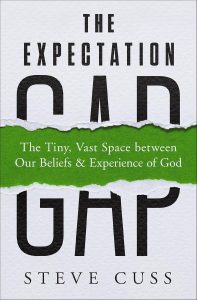
The Expectation Gap: The Tiny, Vast Space between our Beliefs & Experiences of God
by Steve Cuss
Without question, one of the top ten books I have ever read on spiritual formation. His questions alone are worth the price of the book.
Introduction – Gaps and Traps
Steve claims that many of us struggle with a gap between what we believe about God and what we experience from God.
Steve believes that there are three gaps:
-
- I believe God loves me, but I don’t feel it.
- I believe God is with me, but I don’t see him.
- I thought I’d be further along by now.
Ask yourself this: Do you truly experience the benefits Jesus said you would get when you follow him? Sit with God with that question.
Steve said: “I have found that if I can encounter God’s peace, freedom and love even 10 or 15 percent of the day, it can be transformative.”
Deepest versus Most Precious Beliefs
Steve said: “I discovered that I hold beliefs even deeper and more foundational to me than my belief in Jesus.”
Take some time in Jesus’ presence with this question:
Jesus, what are the beliefs that I hold more deeply than my belief in You.
Indented texts are quotes from the book.
Chapter 1 – Our False Reality
Steve starts us out with:
Our assumptions about ourselves play a critical role in creating and maintaining the gaps between our expectations and experience of God.
He also claims that the same dynamics that infect our friendships, marriages, and families also impact our relationship with God.
Steve says that we have two core relationships in our lives: God and ourselves. If you make one simple shift in each of these relationships, your capacity to experience God will expand.
These two shifts and four dynamics will help increase our capacity for connectedness and also increase our awareness of when we are disconnected.
Shifts:
Shift #1 Put Yourself on Your List of Your Relationships
The first shift is simple enough: we need to add ourselves to our conscious list of relationships. It may sound odd at first, but one key reason we struggle to connect to God is that we are often profoundly disconnected from ourselves. We simply do not see ourselves as one of our core relationships. If someone asked you who is in your family, you would list your immediate family, of course, but I’m guessing you would be down to your great-uncles and second cousins once removed before you ever think to include yourself.
I speak to myself in a way I would never speak to a friend. Up until a few years ago, I frequently called myself a “moron” or “stupid” without any regard for myself. I tell myself to get over it and suck it up, but I would never do that to someone I love.
Here are some signs Steve gives that you have not put yourself on your conscious list of relationships:
-
- You are there for others, but you struggle to ask for help for yourself.
- You are very patient with others but highly impatient with yourself.
- Your inner critic speaks so loudly that you cannot hear the compliments of others.
How are we ever going to relax into the love and presence of God if we allow our inner voice to run the show?
The more I allow myself to be exactly human-sized, the more I bump into God, making space for God instead of filling the space with my incessant need to do or to people-please or to rush in.
#1 Tool in the book: take seriously your relationship with yourself, and care for yourself the way you care for the people you love.
Treat yourself with the same kindness and courtesy you give to others. Check in with yourself the way you check in with your friends and family. Ask yourself, How are you? and wait until you know the answer.
When we put ourselves on our conscious list of relationships, two foundational shifts happen:
-
-
-
- We learn to be as kind to ourselves as God is to us, and thus our inner chatter begins to line up with God’s truth; and
- We discover that we can connect with God because we have paused long enough to “be still, and know” that God is God (Psalm 46:10). We become aware of the ways in which all that is within us is blocking our capacity to notice God.
-
-
Shift #2: See Your Relationship with God the Way You See Your Relationship with Others
The second shift has to do with the way we see our relationship with God. I am asking you to see your relationship with God the way you see your relationships with other humans.
What might it look like to relate to God in the same way you relate to people? Spend some time in Jesus’ presence with that question.
Core Relational Dynamics [with God and with Others]
1. Assumptions
Assumptions are the way we make meaning out of something we think we know but do not actually know. Knowing / Being aware of what our assumptions are is the starting point.
There are no true assumptions. There are assumptions that are true – but you don’t know it. If they were true they would not be assumptions.
Lord, what assumptions am I making about you?
I think I have no assumptions about You – but I ask You to reveal any as the week goes on.
2 . Reactivity
When we do not get what we think we need in a given situation, we get reactive.
How can you know your reactivity? You can begin by noticing three signals:
-
-
-
- your anger
- your shame
- your core values.
-
-
What makes you angry? What quickly fills you with shame? What happens when someone violates one of your core values? What do you do next? Welcome to your reactivity.
When we are filled with reactivity, we get either bigger or smaller than human-sized.
3. Stuck Patterns
When talking about stuck patterns, Steve writes:
I certainly don’t pause and ask God for God’s insight on the matter.
I have a stuck pattern (concerning my dismissal) and I do pause and I have asked for insight, and I am still stuck in this pattern.
He claims in his case it is a stuck pattern based on assumptions. Are there assumptions in my case?
He recommends changing your side of the stuck pattern – but in my case I don’t see it as their problem at all.
Or do I? Yes, it is. I assume that they need to change/repent/confess/admit lying / change. “It’s me that has to change.” That is a path I will try.
Stuck patterns are powerful; they keep us disconnected, expending energy that is unproductive.
Yes, powerful – but they do not keep me disconnected, but definitely expending unproductive energy.
We are often more intent on winning than loving, being heard than listening, protecting yourself from harm than healing the relationship.
4. Attempted Solutions
This is the weakest dynamic. Family therapist Jay Haley famously told his clients, “I don’t address problems; I address attempted solutions.”
Some problems are actually made worse by our attempted solutions.
For example, someone posts an inflammatory statement on social media, and you become reactive. But you do not know you are reactive. Your reactivity is generated by assumptions you hold about yourself and the person who posted-that person clearly needs to be corrected, and I’m the one to do it. You do not realize you are operating out of assumption and reactivity. You are just living your one wild and precious life. But your brain is deceived in that moment. You are no longer able to see reality, and you become infected by reactivity. So you comment on their post with a corrective response. It may be very direct, or it may be couched in soft language. You believe your comment will help the poster see the error of their ways, or maybe you just enjoy putting people in their place. Whatever your motive, your comment is an attempted solution.
After you reply with your corrective comment, the thread quickly devolves into something like a playground argument. Assumptions and reactivity fly around wildly, and everyone on the thread catches them like viruses. This whole situation is a stuck pattern.
Summary of the Chapter and Questions – Dispelling the Illusion
We bring assumptions, reactivity, stuck patterns, and attempted solutions into our relationship with God that keep us from encountering God because they put us in a false reality
Some of the challenges in our relationship with God come from God’s side:
-
-
-
- He is invisible
- He speaks intermittently
- Jesus said he was coming back soon – 2000 years ago – that sows seeds of doubt
- We believe God is all-powerful and also all-loving and all-knowing, but God does not intervene as often as we would like or in the ways we would like. God can do so but doesn’t.
- When we live in reality and truth, we can more easily access God’s presence.
-
-
Questions
-
- What do you think of the idea of putting yourself on your list of relationships?
- How might being kind to yourself help you encounter God’s kindness?
- What assumptions do you hold about God or about yourself that might be blocking your connection with God.
- What situations make you reactive? Do you typically get bigger or smaller than human-sized?
- When you are reactive, do you struggle to notice God’s presence?
- Can you name any stuck patterns you see in your faith or in your human relationships?
- Attempted solutions can be hard to identify. Do any attempted solutions come to mind?
Chapter 2 Relaxing into God’s Presence
If you want to connect deeply with God, you first have to connect deeply with yourself.
Focusing on myself was painful. But how can I empty myself, deny myself, and die to self if I am completely unaware of myself?
TOOLS TO OPEN YOUR SOUL TO GOD
Pause
Pause long enough to increase awareness—awareness of yourself and of God. Do you know what is going on in you? Can you articulate it to God or to someone else?
Radical Acceptance
I am certainly much harsher to myself than I would ever be to another person. What would it look like if you radically accepted yourself?
Permission
There is a problem when we: refuse to give myself permission to be human or to feel my feelings.
To grow out of being hurt is to grow out of being human.
Curiosity
Curiosity helps us locate assumptions and keep judgment in check. It helps us explore what is beyond what we think we know for sure.
Testing Assumptions
Over and over, Jesus said, “You have heard that it was said . . . But I tell you . . .” (see Matthew 5:21–48). Might this be the path to spiritual transformation?
Reflection and Debriefing
Jesus used Action-Reflection-Action most famously when he sent out his disciples two by two (see Mark 6:7).
See my: Do and Observe Sermon
Laughter and Playfulness
Laughter and playfulness are drastically underutilized in spiritual growth.
Laughter increases my capacity to do difficult work.
Time
The tools in this book are designed to unlock some deep changes that take time to forge.
Intentionality
I recommend intentionally cultivating the practice of relaxing into God’s presence in the morning and evening, as well as cultivating the tools and postures above.
End of Chapter Questions
-
- What intense situations have revealed to you what is bubbling underneath the surface in your life? What was that revelation like for you?
- As you consider the way you treat your loved ones versus the way you treat yourself, what differences or similarities do you find?
- What could change for you if you began to treat yourself kindly?
- Where have you seen anxiety become contagious within a group?
- Which of the postures and tools can you try this week?
- Which of the postures and tools do you think you will struggle with the most?
Chapter 3 Gap 1: God’s Particular Love “I believe God loves me but I don’t feel it.”
It is difficult, isn’t it, to experience God’s love?
The most likely obstacles we face in encountering God’s particular love for us are The Stories We Tell Ourselves.
Our inner critic is the voice of condemnation that speaks anytime we let ourselves down, anytime we do not live up to our own standards.
To stand and receive God’s unconditional love without pretense is scary.
My inner critic has four core, recurring messages:
-
-
-
- You should know better by now.
- You are stupid and exposed.
- You cannot do it.
- You are not worth loving.
-
-
Does your inner critic’s view of you contradict God’s view of you?
As long as The Stories We Tell Ourselves and The Way Things Are remain unexamined, unexposed, and unspoken, we will struggle to encounter God’s love
Our deepest core beliefs can be difficult to uncover because they are subconscious. They have been with us since our early memories, and they are fierce in protecting us from pain or lack.
So as adults, we have been living with them and depending on them for decades without considering their negative impact or whether they are even true.
Our inner critic is one of several task force members within our soul who serve on The Stories We Tell Ourselves committee. We may or may not be aware of this committee. The members mostly work undercover, but together they create two core messages:
-
-
-
- The Stories We Tell Ourselves
- The Way Things Are
-
-
These messages are a complex web of untested assumptions and thinking patterns that form our deepest core beliefs. The committee means well. It exists and speaks to protect us from vulnerability and hurt, and is forged from experience, especially childhood experience.
As mentioned, our inner critic serves on this committee. Who else is there? Each of us has a few members in common
The Stories We Tell Ourselves Committee
Your Unique Members
Steve identified some of his committee members:
-
- I call one of them the “it’s all downhill from here”
- Another member serves as my prayer editor.
- Some operate as soldiers … These soldiers reported for duty after a significant trauma or abuse in our past. They struggle to discern true threats from perceived threats; they trigger us in both, blocking out love and connection from healing humans and from God.
Who are the committee members that are unique to you? Take some time in God’s presence and identify them.
Our Common Committee Members
We’ve already mentioned the inner critic
Family of origin propagandist – takes assumptions and beliefs from family of origin and make them core beliefs. His family of origin feeds two basic messages:
-
-
-
- Cusses don’t ask for help. They help others
- Others have it worse. Don’t complain.
-
-
Childhood agreement officer – The problem is, we become adults and no longer need these hyper-vigilant protective mechanisms.
Sifting Our Beliefs
Let’s get into the core messages.
-
-
- God is busy helping those who need it more than me.
- My problems are not really problems.
- I must be self-sufficient; I can never be weak or vulnerable.
- My feelings are not valid; I do not have the rights to them.
- Strong people figure it out on their own.
- People must see me as smart for me to be okay and for the world to be okay.
- God loves me generically, not specifically. God loves me as just another generic person because that is God’s job
-
My brain says there’s no way I could actually believe the list, but my actions, my deepest thinking, and my fear offers counter-evidence.
In what ways do you live your life or see the world that keep you from being vulnerable and exposed?
The Tangible Love of God
I am simply suggesting that we all can choose life over self-condemnation. It is much better news. I propose that we place our faith in something more reliable than our own opinions.
If we do that long enough, over time God’s love will become as tangible as The Stories We Tell Ourselves, and we will discover the story that has been guiding us and speaking to us for decades is not as reliable or true as we assumed it was.
Questions for Discussion
-
- What committee members are you aware of in your life? Can you name a couple of them specifically?
- What might be an aspect of The Stories We Tell Ourselves that you would like to examine?
- What positive message have you inherited that might become a stronghold? (For example, being responsible is a good trait, but always being responsible for everyone’s experience is a stronghold.)
- What negative experiences or messages would you like to explore?
- Would you like to explore trauma or abuse with the help of a professional? (You can seek out a local church or go to psychologytoday.com and search for “Christian, Trauma,” in your city.)
- If you are ready to do so, list some core beliefs about yourself, the world, or God that might be blocking your capacity to receive God’s love.
Chapter 4 Containing the Inner Critic
For grace to be grace, it must give us things we didn’t know we needed and take us places where we didn’t want to go. Kathleen Norris, Acedia[1] & Me
The biblical narratives rarely give us insight into what people are thinking or feeling. It normally tells us what they are doing. An example can be seen in Luke 22 describing Peter’s denial:
59 And after an interval of about an hour still another insisted, saying, “Certainly this man also was with him, for he too is a Galilean.” 60 But Peter said, “Man, I do not know what you are talking about.” And immediately, while he was still speaking, the rooster crowed. 61 And the Lord turned and looked at Peter. And Peter remembered the saying of the Lord, how he had said to him, “Before the rooster crows today, you will deny me three times.” 62 And he went out and wept bitterly.
Steve points out that the Scripture doesn’t tell us what Jesus was thinking. What do you think Jesus was thinking? Your answer will reveal some assumptions about how you see God and Jesus. Steve goes on:
In most Bible stories, we project thoughts and feelings onto the people. If we pay attention to these projections, we can learn about our assumptions… assumptions put us in a false reality, and truth sets us free.
When Steve asked this question to hundreds of people, the most common answers are “disappointment,” “betrayal,” “anger,” “sadness,” and “hurt.”’ He then asks: “Why don’t we see love and forgiveness?”
What is the difference between the voice of our inner critic and the voice of the Holy Spirit? Our inner critic condemns and the Holy Spirit convicts. Our inner critic blames and condemns us at our core identity level; the Holy Spirit addresses our behavior and thoughts. Our inner critic keeps us stuck with no path to redemption; the Holy Spirit offers repentance, repair, forgiveness, and a path to relief.
Tool: Containing the Voice of Your Inner Critic
You cannot stop your inner critic from coming to work and from speaking, but over time, you can consciously choose to let God have the final word.
Write down some of the messages of your inner critic
What do you think your inner critic needs? How might you invite it to stand down?
Fill in the blank in the following sentence: What if I were at least as ______________________________ to myself as God is?
Read 1 John 3:19-20 in The Message
This is the only way we’ll know we’re living truly, living in God’s reality. It’s also the way to shut down debilitating self-criticism, even when there is something to it. For God is greater than our worried hearts and knows more about us than we do ourselves.
This simple table can help silence the inner critic. When we compare the descriptions of the “gospel” of our inner critic to the true gospel of God, we see the stark contrast.
| List Adjectives that Your Inner Critic Uses about You and those the Gospel Uses | |
| Inner Critic | Gospel |
Tools: Other Committee Members
Childhood Agreements Officer
Childhood agreements can be conscious or unconscious. Their general themes are protection and pain avoidance. We can forge them from one incident, but often they come from a series of incidents
Childhood agreements can take time to locate. It is okay if you are not ready to try the tools on this page; feel free to come back to them when you are.
Name an event or a series of events that may have generated a childhood agreement.
What agreement did you make with yourself to protect yourself from future harm?
Fill in the blanks in the following sentence that describes a childhood agreement. I will __________ so that ____________ will never happen again.
Where do you see this agreement keeping you stuck as an adult?
Compare your agreement with what is true about God.
Family of Origin Propagandist
List three or four assumptions or expectations you have inherited from your family of origin.
What are a couple of assets and a couple of liabilities you carry from your family of origin?
What meaning have you made about yourself from those?
What meaning have you made about God from those?
As you compare the meaning you made from your childhood agreements and family of origin with the gospel of God, is it true?
Tool: The First and Final Word
If Steve was ever summoned before the King of England, there are certain rules he would have to follow. One is that the king has the first and final word.
For followers of Christ, God is our sovereign King, but too often we let our inner critic get the first and final word. It takes faith and practice to live in such a way that God has the first and final word in our lives. We give more weight to what [the inner critics] say than what God says.
How Steve found to silence the inner critic
For a couple of years, I tried to stop my inner critic from speaking. I tried to fire it one time, but the next day it still showed up to work. That is the insidious nature of the committee
Now I let my inner critic say its piece, but I no longer give it the final word. I do not eliminate my inner critic’s voice; I contain it with the truth of God.
I’ve been living by faith—faith that God knows better than me. God’s first and final words orient my days. My inner critic still yammers, and I let it say its piece, but once the word has been spoken, I intentionally frame its word between God’s good words.
Chapter 5 Gap 2: God’s Visceral Presence “I Believe God Is with Me, but I Don’t See Him”
Everything I’ve ever let go of has claw marks on it. DAVID FOSTER WALLACE
Steve describes how some movies and television shows (The Sixth Sense, The Sting, Homeland) use an unreliable narrator to engage us with the story. He goes on to say: “An unreliable narrator is exactly like it sounds – the voice in a story that tells us what’s going on is giving false or misleading information.” He tells us that we have a narrator in our lives. And the narrator is powerful. For example, when someone compliments us, the narrator will say: “That’s not true. He tells everyone that.”
The false narrator in our lives makes us aware of false needs. Things we don’t really need but the narrator convinces us or tries to convince us that we need them.
“When we look at them soberly, we know they are false, but in the moment, our narrator is awfully convincing that they are true needs and that we are in danger if we don’t acquire them. … Unreliable narrators are one reason why we stay in stuck patterns for years. One way you can measure your unreliable narrator is to notice how it exaggerates the stakes if you do not get your false need.”
The Big Five Core False Needs
1. Control
He provides some examples – but I am not connecting with them. His examples are people who lead meetings where someone steers the meeting in the wrong direction. When a control freak goes out to eat, and someone suggests a restaurant the control freak knows will be a bad experience, they try to shift the opinion for the better good. They need people to behave in a certain way. When they don’t get their false need of control met, they get anxious. Perhaps I have a false need to control. I don’t think so.
Here are some better (IMHO) examples of control freaks:
-
-
- Constantly criticizing others
- Needing to win at all costs
- Having difficulty delegating tasks
- They may also exhibit perfectionism, become easily irritated
- Struggle with maintaining healthy relationships
-
2. Perfectionism
Again, his examples do not hit home with me.
-
-
- Believe they need to get it perfect the first time
- Don’t see the good in their work – I could have done it better
- They get an A but in their heart know that it is a B-
- They need others to know that they can do better
-
Here are some better ones (again IMHO)
-
- A perfectionist never completes something
- A perfectionist has a hard time sending off the letter, the article, or the software.
3. Knowing the Answer
You need others to know that you know the answer
4. Being there for others
You need to be there for others who are hurting.
5. Approval
Craving the approval of others
We spend too much of our time living in someone else’s brain. What are they thinking? What do they think of me? Disrespect is a huge trigger.
Summary of the Big 5 (Five Core False Needs)
Where do you find yourself in the Big 5? Perhaps you look at this list and think, I’m doomed. I am all five. If you see yourself in all five, take heart. … You can be free. Your first step is to discern which of the Big 5 is foundational for you.
ACUTE AND CHRONIC ANXIETY
Detangling true needs from false needs can be difficult but fruitful work, and it begins by locating ourselves in the Big 5. Technically what we are doing is detangling our acute anxiety from our chronic anxiety.
Acute: When we have a true need that is not being filled.
Chronic: When we are not in real danger. It is based on a false need.
Chronic anxiety does not dissipate on its own; it has to be displaced. … It pushes us to strive for something we can never achieve.
THE FIRST TEMPTATION
Five impossible goals:
-
-
- We will never be in control;
- We will never do it perfectly;
- We will never know all there is to know;
- We will never be there for everyone in need
- We will never get everyone to like us
- The 5 Core False Needs are Five Core Traits of God
-
God is in control;
-
-
- God does it perfectly;
- God knows all there is to know;
- God can be there for everyone in need
- God gives us approval
-
Our false needs stem from our need to be like God – original sin
It is difficult to notice God when we are trying to be like God.
Each of the Big 5 has a human-sized equivalent.
Our Big 5 false needs are typically the twisted extremes of our gifting. … Anytime we try to carry more than God designed us to carry, we become filled with chronic anxiety.
Most people do not know they are anxious until they experience an extreme level of anxiety
I was anxious in 2001 but had no clue until my heart started misfiring. Since then, periodically my heart starts misfiring, and I know that there is anxiety lurking in me somewhere. So don’t wait for “an extreme level of anxiety” before you realize that you are anxious.
We can relax into God’s righteousness every day by giving ourselves permission to be exactly human-sized, which is all that God ever expects from us.
Remember that only God is God-sized. When we pause and focus on who God is and who we are in God, we relax and start worshiping.
Discussion Questions
-
-
- Which of the Big 5 are you most prone to: control, perfection, knowing the answer, being there for people, or approval?
- Can you recall a recent time when you succumbed to one of the Big 5? What happened?
- What is an unreliable narration in your life that can get you into trouble?
- Jesus died, so I don’t have to ________ anymore. What words or phrases would you use to fill in the blank for you?
- Jesus died to free me from needing _______ anymore. What words or phrases would you use to fill in the blank for you?
- What are some signs that alert you to the times when you stopped noticing God?
-
Chapter 6: Addressing Chronic Anxiety
Believing takes practice. MADELEINE L’ENGLE, A WRINKLE IN TIME
…hubris often masks false needs—control, perfection, and more. And wherever false needs are being chased, chronic anxiety is sure to be lurking.
Tool: God with me; God ahead of me
Steve provides a step-by-step process to consider trying to help us cultivate an awareness of God’s presence
Prework: First identify the signs or signals that you are forgetting God’s presence. Here is Steve’s list:
-
-
- Worrying my way to peace
- Low-grade rumination – thinking hard but never resolving anything
- Self-pity or indignation – when I feel people have to know how bad my situation is
- Anger or arrogance – when I feel the need to put someone in their place
- The desire to escape or watch TV
- A tendency to exaggerate my situation
-
Once you notice your trigger, you can begin the following steps:
-
-
- Pause
- Remember that God is with you
- Remember that God is ahead of you
- Leave the results to God
- Use this tool proactively
-
Tool: Anxiety freedom and the Gospel
He encourages us to use the following table and look at the Big 5 and ask:
-
-
- What can God do?
- What can man do?
- What happens when I try to do God’s job?
-
| The Big 5 | God-sized job | Human-sized Job | Impact on me and others when I try to do God’s job |
| Control | |||
| Perfection | |||
| Knowing the Answer | |||
| Being there for People | |||
| Approval |
Tool: Restrain and Reflect
I find that my chronic anxiety and my unreliable narrator tend to block my awareness of God in the moment, but if I can restrain my impulses long enough to reflect on them with God, I have a much better chance of seeing reality.
Steve goes on to say that after restraining and reflecting, he still may not know what to do, but he has the peace that God has got things under control. But that brings up the question: What are my recurring impulses? That is a good question to pursue.
“A keen awareness of our recurring, predictable impulses can help us learn to control them”
Also, he says that we should learn where these triggers happen. What are some of the situations where you know these impulses will be activated?
Okay, now you have found the where and the what – but we know that awareness does not alone bring about change. It is the first step towards change. We need to catch it when it happens. And then Steve proposes that you:
stop and remember that God is with me and ahead of me
But then how will you do that? Again that’s the rub.
THE NATURE OF EVERY GOSPEL
Steve tells us that there are many gospels in our world. He defines a gospel as a “path to the good life.” He says that every gospel has three things:
-
-
- Promise (what good will be achieved)
- Path (how you get there)
- Payment (what it will cost you)
-
I am not so sure it fits the good news aspect of the Gospel. It seems more than that. Let’s call it “The Carrot.” It is what we are going after. If we do this (The Path), this will happen (The Promise), and it will require this much (The Payment). The True Gospel can be thought of as “The Carrot.” But many false Carrots promise us something; there is a path to get there, and a price we will pay for obtaining that false Carrot. He tells us to pursue the following questions:
-
-
- What false Carrots have you been pursuing in the past or even now?
- What was the path that you went on (or are on)?
- What did it cost you (or still is costing you)?
-
One of the most powerful and liberating tools I use is paying attention to what I am believing at any given moment (my unreliable narrator) and then mapping out what the path is, what the promise is, and who is paying.
DISCUSSION QUESTIONS
-
- What situation is coming up this week where you might practice “God with me, God ahead of me”
- Do you have a situation coming up where you are carrying more than you can carry?
- When have you been able to “relax into the presence of God”? What was that like for you?
Chapter 7 Gap 3: My Spiritual Progress
“I Thought I’d Be Further Along by Now”
Christian maturity is not a matter of doing more for God; it is God doing more in and through us. Eugene Peterson – Practice Resurrection
The reason we think we should be further along by now is connected to how we read the Bible, how we compare ourselves to others, and then how we reinforce these dynamics in our faith communities.
Many of us spend too much spiritual energy—and, frankly, guilt—trying to be something God did not ask us to be.
Looking at how we read the Bible (Dallas Willard taught me this) we can put ourselves in the story. But so often we put ourselves as the main character. For example, in the story – Jesus walks on water- we can, as John Ortberg says–if you want to walk on water, you need to get out of the boat. We put ourselves in the impetuous, act-first-think-later, risk-taker Peter’s place, and we are a meditative, contemplative server of people.
11 were in the boat and they all worshiped Jesus at the end of this. So 1st recommendation is to be careful as we read the text this way – which character we put ourselves in.
Those of us in cultures that place a high value on performance and improvement are prone to see every story in the Bible as “something I need to work on,”
What if most of the stories in the Bible are designed to primarily evoke a worship encounter with God rather than a self-improvement task list?
There is room in you to be exactly one human, and God wants to transform you—not into a super-disciple, but into a human-sized you.
One way to summarize this section of the book is that Stephen is telling us that we are not supposed to become the sum of all the wonderful characters in the Bible: a leader like Moses; a fighter and a songwriter like David; courageous like Esther; long-suffering like Jeremiah; bold and brash like Peter; a contemplative like Mary. God wants us to be a human-sized us.
If you count every unique day captured by all the gospel writers, the total number is between fifty-two and fifty-seven. The Gospels capture less than 5 percent of Jesus’ public ministry. What did He and the disciples do the other 95% of the time.
We never see the disciples shopping or doing laundry, or frankly engaging in recreation.
The Bible concentrates on “God-soaked moments.”
Final Comparison Frontier
God’s job is to form us into Christ-like-ness, but we are prone to make it our job because we so quickly move into the seat of control.
The primary emphasis of our own spiritual growth effort is not so much becoming like another person or like God; it is dying to self
We cannot be like Jesus, because when we try, we end up creating Jesus in our image and losing sight of the true Jesus.
The fruit of the Spirit is what God forms in us after we die to ourselves.
God is more interested in us bringing our whole selves to him in worship than he is in our improvement.
God has changed me to seek him sooner when I am reactive rather than addressing my shortcomings on my own like I used to.
If we focus primarily on dying to ourselves and worshiping Jesus—seeking to encounter the true Christ—we can ease into being human-sized, relax into God’s presence, and be free to serve, sacrifice, and be stretched, challenged, and rebuked.
DISCUSSION QUESTIONS
-
-
- Are you prone to try to always be like the main character of every Bible story? What has that been like for you?
- Is there a person in Scripture you most relate to? What attributes do you share?
- How can God redeem and use those attributes for the sake of others?
- How would you say a person grows in Christ?
- How do you discern God’s will today?
- What aspects of following Jesus were more straightforward in Bible times, and what aspects were more difficult?
- What most helps you encounter the invisible God today?
-
Chapter 8 – Replacing Unhealthy Assumptions
Begin by making a list of things Jesus can do that you and your friends will never be able to do, no matter how hard you try. Here is the start of mine:
-
- Create the world
- Hold it together
- Indwell through His Spirit other people
- Completely and perfectly love – “When in your life recently have you felt most fully and completely loved?”
Steve then recommends making a Life-Giving List. The Life-Giving List is simply a list of the people, places, and activities God has given you that make you feel human, connected, and alive. Here is my list
Life-Giving List
| People | Remote or Local | Places | Distance from House | Activities | Cost in Time and Money |
| Former co-worker | Remote | Trapp | 4.5 hours | Reading | 0 |
| Pastor | Local | Ft Myers | 26 hours | Being with good friends | 0 |
| College Roomate | Remote | Barkhamstead back reservoir | 40 minutes | Baking | 0 |
| Directee | Local | Farmington River | 5 minutes | Walking | 0 |
| Simsbury Farms Golf Course | 17 minutes | Fixing things | 0 | ||
| Writing | 0 | ||||
| Running on beach | 0 | ||||
| Alone in God’s presence | 0 | ||||
| Being with Barbara | 0 |
Steve says:
I use the list in my daily connection with God. I also use my calendar and budget to make time for the longer and larger items on the list.
Steve has more than 160 items on his list. He uses it as a worship document.
The Life-Giving List helps me increase my threshold for worship, and, perhaps most powerfully, it massively expands my scope and palette of what worship is.
TOOL: BIBLE STUDY, PRAYER, AND QUIET TIME
Though Steve recommends these classic spiritual disciplines, he sees two problems with them.
We have narrowed the way we interact with bible study, prayer and quiet. We try to do it as it works for others.
It does take time, reflection and study to get all you can out of these three disciplines.
CULTURAL FORMATION; FLIPPED VALUES AND PAUL
You might say we are discipled by our culture and times, just as we are discipled by Jesus. Sometimes this discipleship is a competition, as when the values of the culture compete with the values of God’s kingdom. Other times, we see the values line up.
Steve attempts to make a point that many of the statements in the Bible do not translate in our culture. He then uses Paul’s statement – “To live is Christ, to die is gain.” He says it’s wrong to translate that into our life. I think he misunderstands what Paul means. Yes, Paul wanted to go and be with the Lord. But if we take in Richard Hayes interpretation of Paul’s theology, we see that this is a universal statement – not a cultural one. In other words, we will be better off when we die, but right now we are called to live here on earth.
CULTURAL FORCES AND THE GOSPEL
How do we live faithfully for Jesus while being formed and forged by our unique times? The answer is not feeling guilty that we feel differently than Paul, and it is not trying to be more like him.
I have found it most helpful to become aware of the forces at work that drive and compel me, the unique challenges of discipleship in my own time and place
These conversations are complex and best done in community.
I live in the United States. Four core values where I live are freedom, personal rights, safety, and wealth-building for security
Jesus is much less concerned with my personal safety than I am.
Steve sees some cultural forces that line up with the gospel:
-
-
- Generosity
- Valuing the success / encouraging the success of others
-
He then gives more questions to ponder:
-
-
- What values do you think oppose the gospel?
- What values do you think line up with the gospel?
- What can you do this month that helps you swim against the cultural norms that oppose the gospel?
-
“You have heard it said…”
Steve tells us that we think that progress in the faith is about learning – but a lot of it is about unlearning.
Look at the gospels and discover how much of Jesus’ discipling is unlearning.
Chapter 9 Home and Shalom
We come to God by love, not by navigation. St. Augustine
SHALOM AND SELF-RIGHTEOUSNESS
Home is anywhere we are fully welcomed and accepted, free to love and be loved. Our guard is down; we do not need to strive; we do not need to be anything more than we are; and we are well. We are well with God; well with ourselves; well with other people.
We are rejuvenated, breathing easy, and thriving. But we are not just receiving. Our hearts are opened up to freely give to others. Home is not necessarily comfort, nor is it safe, but it is always belonging, always encountering love. Home is where we experience God’s profound and specific love for us. We are able to relax into it and then generously pour it out to others, including marginalized people and enemies. Going home is what allows us to risk, explore, and sacrifice for the needs of others.
If this is home, then the Hebrew Scriptures word for it is shalom. The word shalom makes most of us think of a greeting or “peace.” That is a fine start, but shalom goes much deeper than our modern understanding of peace. It has more to do with human flourishing than simply a peaceful existence. When we translate words from one culture to another, they can lose some horsepower.
Shalom means “thriving,” “wholeness,” “ well-being.” Shalom is not measured simply through individual wellness; the wellness of an entire community is in view here. True shalom involves every relationship in a society—with ourselves, God, our people, strangers, the under-resourced, enemies, immigrants, creation, all of it. All people are well, not just the well-off and well-to-do.
How do we know when we are well? One of the simplest ways is to learn what it feels like to be connected.
Peace is not the absence of things we don’t like, but the sensed presence of the Prince of Peace.
Learning to practice home and shalom in his chaplaincy amid pain and suffering, Cuss learned that we can experience home and shalom anywhere.
The call to repent in the scriptures is an invitation to shalom.
God sees sin as more of a breach than a list.
Most of us think that God punishes us when we sin. But more accurately, sin punishes us when we fall short.
Herbert McCabe suggested that the reason to avoid sin is that it pollutes our thinking. Sin makes us think that God has changed His view of us
McCabe proposed that sin doesn’t change God’s view of us; sin changes our view of God’s view of us.
In his book Orthodoxy, G. K. Chesterton claims that sin ages us.
Chesterton says God must be playful like a child because a child never tires of repetition. … Chesterton provokes our thinking, suggesting that God is better at being a kid than we are. Chesterton writes, “We have sinned and grown old, and our Father is younger than we.”
What does it mean to become like a child – never tire of repetition – me
I have heard the exact opposite teaching to this teaching from Bernard of Clairvaux, “Sermon 18, ‘The Two Operations of the Holy Spirit,’:
The man who is wise, therefore, will see his life as more like a reservoir than a canal. The canal simultaneously pours out what it receives;the reservoir retains the water till it is filled, then discharges the overflow without loss to itself. . . . You too must learn to await this fullness before pouring out your gifts, do not try to be more generous than God.
That doesn’t take away the truth, but we are to be reservoirs in some ways and canals or rivers in other ways.
Discussion Questions
-
- Where is home for you?
- What “home” work might you try this week to experience home?
- When you think of the word sin, what primarily comes to mind?
- What do you think of Herbert McCabe’s notion that “sin distorts our view of God’s view of us?”
- When do you feel most fully and completely loved? 6What life-giving habits will you cultivate ib the next 30 days?
- What might it look like to try to be “more generous than God”? What might you do this week to serve out of the overflow rather than pour everything out?
Gauntlet Questions (Terrible party ice-breakers)
When I trained as a spiritual director, I accumulated a 20 page document with the best questions to ask during spiritual direction. These are Steve’s best questions to get to know someone. Most of these are excellent. I will add them to my list:
-
- How do you know when you are not well?
- What practice—that takes five minutes or less—helps you connect with God?
- What sort of leadership situations generate anxiety for you?
- What type of people trigger you the most
- What do you do to stay connected to them?
- Sometimes we can be the last to know when we’re not okay. Who in your life knows before you know?
- When you think about your family of origin, what is one asset and one liability that you’ve inherited from them?
- In the absence of information, people connect the dots in the most pathological way possible. What goes through your mind when you’re anxious but don’t have all the information?
- In your leadership, where do you keep running into yourself? What trait do you wish you could break?
- Criticism is tough. What type of criticism most affects you?
- Cumulative criticism can take you out. Tell us about a season that felt like unrelenting criticism.
- What if I were at least as _______ to myself as God is?
- Where do you experience a gap between what you believe and what you experience?
- How do you mind that gap?
- If you treated yourself as well as you treated others, what one way of dealing with yourself would you change?
- Can you share a time you witnessed a miracle? What happened?
- What have you found helpful to do in order to deal with loneliness?
- When recently have you felt free?
- Tell us about a time in the last few weeks when you were at peace.
- What have you found helpful to do in order to deal with loneliness?
- When recently have you felt free?
- Tell us about a time in the last few weeks when you were at peace
[1] Acedia is a state of spiritual apathy